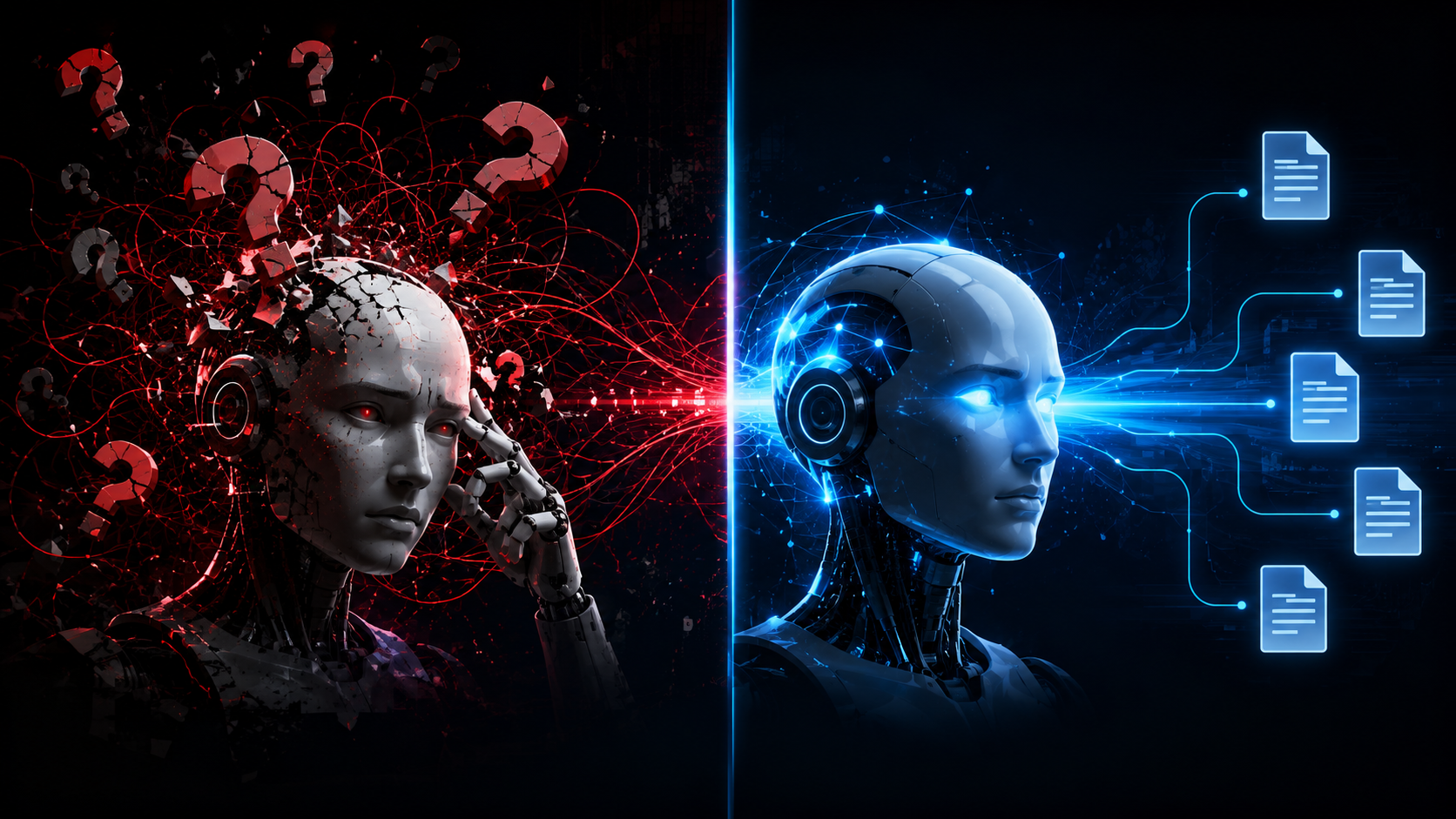
## The Knowledge Gap: Why LLMs Need RAG
Large Language Models (LLMs) like GPT-4 or Claude are incredibly capable, but they suffer from a fundamental limitation: they only know what they were trained on. For businesses and developers, this creates a "knowledge gap." Your specific data — internal wikis, customer support logs, or proprietary codebases — is invisible to the model.
Traditionally, the solution was fine-tuning, but that path is fraught with challenges: it is prohibitively expensive, agonizingly slow, and the data becomes stale the moment training ends.
Enter Retrieval-Augmented Generation (RAG). Instead of trying to bake knowledge into the model's weights, RAG provides the model with the relevant source material at the exact moment a query is made. The model doesn't have to "remember" the facts; it simply has to summarize the context provided to it.
## The Architecture of a RAG Pipeline
Building an effective RAG system is less about "prompt engineering" and more about data engineering. The process follows a predictable, four-step lifecycle.
### Step 1: Strategic Chunking
The first step is breaking down large documents into smaller, digestible pieces called "chunks."
- Why it matters: LLMs have limited context windows. If you feed an entire 100-page manual into a prompt, you'll hit a wall.
- The Best Practice: Semantic chunking is the gold standard. It involves splitting text based on meaning rather than just character counts.
- The Overlap Factor: Adding a small amount of overlap between chunks (e.g., 10-15%) is vital to prevent context loss, ensuring that ideas aren't cut off mid-sentence.
### Step 2: The Power of Embeddings
Once we have our chunks, we need to turn them into something a computer can understand: numbers. Specifically, high-dimensional vectors.
- The Goal: Embeddings represent the "meaning" of a chunk in a coordinate space.
- The Benefit: This allows the system to perform similarity searches. If a user asks about "fixing a screen," the system can find chunks about "display repair" because they are mathematically close, even if the exact keywords don't match.
### Step 3: Advanced Retrieval
Retrieval is the act of searching your vector database for the chunks most relevant to the user's query.
- Hybrid Search: Professional systems don't rely solely on vectors. They use hybrid search, combining vector similarity with traditional keyword matches (BM25) to ensure nothing is missed.
- Re-ranking: After finding the top 20 potential chunks, a secondary "re-ranker" model sorts them to ensure the absolute most relevant information is placed at the top for the LLM to read.
### Step 4: Grounded Generation
Finally, the retrieved chunks and the original user query are bundled together into a prompt.
- The "Grounded" Answer: By forcing the model to answer using only the provided text, we significantly reduce hallucinations.
- The Result: The model acts as a sophisticated reasoning engine that synthesizes the retrieved data into a coherent response.
## Why RAG Systems Fail
Even with the right steps, RAG is not "plug and play." Most failures occur due to engineering oversights rather than model limitations.
| Failure Point | Impact | Solution |
|---|---|---|
| Poor Chunking | Missing context or fragmented answers. | Use semantic boundaries and strategic overlap. |
| Wrong Embedding Model | Low retrieval accuracy. | Match the model to your domain (e.g., medical vs. legal). |
| Retrieval Imbalance | Too much noise or too little info. | Tune the "Top K" retrieval parameters. |
| No Re-ranking | Irrelevant info confuses the LLM. | Implement a cross-encoder for sorting. |
| Stale Data | Accurate answers to outdated info. | Automate data pipeline refreshes. |
## Conclusion: Engineering the Future
RAG is not magic; it is a well-designed data pipeline. The transition from a "cool demo" to a production-ready application depends entirely on how you handle the nuances of retrieval and the quality of your data engineering. When properly executed, a RAG system transforms an LLM from a generic chatbot into a trusted, domain-expert tool capable of handling your most sensitive and specific data with precision.

BroskiesHub Team
The Team
Insights and perspectives from the BroskiesHub engineering and product team.


