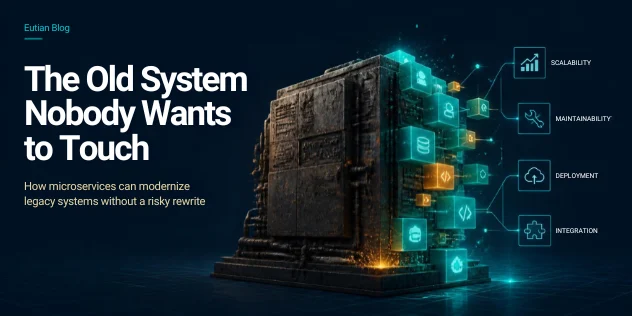
Legacy System Modernization: 7 Strategies, Architecture Patterns, and an Enterprise Roadmap
Researched by Balaji | BroskiesHub
Legacy systems continue to power critical business operations across banking, healthcare, manufacturing, retail, and other industries. Although these applications may have supported organizations successfully for decades, aging technology stacks, complex dependencies, rising maintenance costs, and limited scalability can make them increasingly difficult to maintain and improve.
For modern enterprises, legacy system modernization is no longer just an infrastructure upgrade. It is a strategic process that helps organizations improve software maintainability, strengthen operational resilience, reduce technical debt, and prepare their technology platforms for evolving business requirements.
However, modernizing an enterprise application is not as simple as rewriting its code or moving it to the cloud. Every system has different business responsibilities, architectural limitations, data dependencies, and operational risks. Choosing the wrong approach can increase costs, disrupt production, and delay business transformation.
This guide, researched by Balaji at BroskiesHub, explores seven legacy system modernization strategies, essential architectural patterns, database modernization techniques, and a phased enterprise implementation roadmap.
For more insights into software engineering, enterprise architecture, and modern technology practices, visit BroskiesHub.
What Is Legacy System Modernization?
Legacy system modernization is the process of transforming existing applications, infrastructure, and data platforms to improve their suitability for current business and technical requirements.
A legacy system is not necessarily old simply because it was developed many years ago. It becomes a modernization concern when its architecture, dependencies, operating costs, or maintenance requirements prevent the organization from meeting current needs efficiently.
Common examples include:
Mainframe applications written in COBOL or PL/I.
Monolithic Java and .NET enterprise applications.
Client-server applications built with older development frameworks.
Databases containing tightly coupled business logic.
Applications dependent on unsupported operating systems or proprietary middleware.
Systems with undocumented integrations and limited automated testing.
Over time, these applications can accumulate technical debt, making even relatively small changes difficult to implement safely.
Why do enterprises modernize legacy systems?
Several factors commonly motivate modernization initiatives.
Reduced agility: Large, tightly coupled applications can require extensive regression testing and coordinated deployments whenever business logic changes.
Increasing maintenance costs: Specialized licenses, aging infrastructure, manual support processes, and limited availability of experienced engineers can increase operating expenses.
Security and supportability: Unsupported runtimes and obsolete infrastructure can make security patching and compliance more difficult.
Scalability limitations: Applications designed for fixed-capacity hardware may struggle to accommodate changing workloads efficiently.
Integration challenges: Legacy systems often depend on older communication protocols, shared databases, and tightly coupled interfaces that complicate digital transformation.
Modernization seeks to address these challenges while preserving essential business capabilities and maintaining operational continuity.
The 7 Rs of Legacy System Modernization
Enterprise modernization requires a strategy that reflects each application's business value, technical condition, and future requirements.
The widely used seven-strategy framework includes Rehost, Replatform, Refactor, Rearchitect, Rebuild, Replace, and Retire.
<text color="secondary" size="sm">The timelines and relative costs below are indicative planning ranges from the supplied research report, not guaranteed outcomes.</text>
StrategyPrimary purposeIndicative timelineRehostMove an application to new infrastructure with minimal code changes1–3 monthsReplatformAdopt managed platforms or modern runtimes without major redesign3–6 monthsRefactorImprove internal code quality and maintainability4–9 monthsRearchitectRedesign application boundaries and architecture9–24 monthsRebuildDevelop a replacement application from scratch12–36 monthsReplaceAdopt a commercial or SaaS solution6–18 monthsRetireDecommission an unnecessary application1–3 months
Actual duration depends on system complexity, migration scope, data quality, dependencies, regulatory obligations, and the resources available.
1. Rehosting: Move Legacy Applications to the Cloud
Rehosting, commonly called lift and shift, moves an application from existing infrastructure to cloud infrastructure with little or no modification to its application code.
For example, an enterprise may move an application from physical servers in its data center to virtual machines on AWS, Microsoft Azure, or Google Cloud.
How rehosting works
Inventory the application, infrastructure, and dependencies.
Prepare the target cloud environment.
Replicate application data and storage.
Configure networking, access controls, and monitoring.
Test the migrated workload.
Execute the cutover and verify production operations.
Benefits
Faster infrastructure migration.
Reduced dependence on physical data centers.
Potential savings from retiring hardware and facilities.
Minimal changes to established business logic.
A foundation for subsequent modernization.
Challenges
Rehosting does not remove technical debt or automatically improve application performance. Existing bottlenecks, inefficient database queries, and outdated dependencies may remain.
Cloud costs can also increase when organizations migrate oversized workloads without optimizing their resource consumption.
Best suited for: Stable applications facing data center exit deadlines or requiring rapid infrastructure relocation.
2. Replatforming: Modernize the Application Environment
Replatforming, sometimes described as lift, tinker, and shift, introduces targeted changes to the application platform while preserving its fundamental business logic and structure.
Typical activities include moving databases to managed services, containerizing applications, upgrading runtimes, and replacing legacy middleware.
For example, a self-managed database running on a virtual machine may be migrated to a managed database service, reducing the operational work required for backups, patching, and availability management.
Benefits
Reduced infrastructure administration.
More standardized deployment processes.
Improved operational consistency.
Better integration with cloud platform services.
Potential improvements in resource utilization.
Challenges
A containerized monolith remains a monolith. Replatforming alone does not eliminate tightly coupled modules or enable every component to scale independently.
Teams must also identify application assumptions involving local files, in-memory sessions, or proprietary libraries before moving to managed environments.
Best suited for: Applications with established business logic that would benefit from managed databases, modern runtimes, or standardized deployment platforms.
3. Refactoring: Improve Code Quality and Maintainability
Refactoring reorganizes the internal structure of software without intentionally changing its externally observable behavior.
Legacy applications often contain duplicated business logic, large classes, hardcoded configurations, deeply nested conditions, and limited automated testing. Refactoring addresses these problems incrementally.
Common techniques include:
Removing duplicated code and obsolete logic.
Extracting responsibilities into smaller components.
Introducing dependency injection and clear interfaces.
Separating database access from business logic.
Improving automated unit and integration testing.
Upgrading outdated libraries and frameworks.
Benefits
Refactoring makes applications easier to understand, test, maintain, and extend. It can also prepare a monolith for future architectural decomposition.
Challenges
Hidden business rules can make seemingly straightforward changes risky. Comprehensive regression testing is especially important when applications support complex calculations or long-established operational workflows.
Refactoring also cannot solve every architectural limitation. A well-organized monolith may still face deployment constraints or scaling bottlenecks that require deeper changes.
Best suited for: Applications with valuable business logic and a viable underlying architecture but substantial accumulated code-level technical debt.
4. Rearchitecting: Build Modular and Cloud-Native Systems
Rearchitecting changes an application's fundamental structure to improve scalability, modularity, and independent deployment.
A common approach is to decompose a large monolith into services organized around distinct business capabilities.
For example, an e-commerce application might separate order processing, inventory management, billing, and notifications into clearly defined services.
Several architectural principles support this approach.
Domain-Driven Design (DDD): Identifies business boundaries and bounded contexts that can guide service responsibilities.
Microservices: Enables selected business capabilities to be developed, deployed, and scaled independently.
Event-driven architecture: Uses events and messaging to communicate changes asynchronously between components.
Database-per-service: Gives services ownership of their data instead of requiring every component to access a shared database directly.
Saga pattern: Coordinates business transactions that span multiple services through local transactions and compensating actions.
Benefits
Greater flexibility for independently deployed capabilities.
Improved scaling options for selected workloads.
Clearer ownership of business domains.
Better alignment between engineering teams and business responsibilities.
Opportunities for more frequent and controlled releases.
Challenges
Distributed architectures introduce network latency, eventual consistency, observability requirements, and new failure modes. They can also increase infrastructure and operational complexity.
Rearchitecting should therefore be driven by clear business requirements rather than adopting microservices simply because they are a popular architectural style.
Best suited for: Strategically important applications that require significant improvements in scalability, deployment independence, or business agility.
5. Rebuilding: Replace the Existing Codebase
Rebuilding means developing a new application from scratch while preserving the business capabilities that the existing system provides.
This approach may be appropriate when the legacy codebase depends on obsolete technology, contains extensive structural decay, or cannot be maintained economically.
A rebuild can introduce modern programming languages, cloud-native infrastructure, contemporary interfaces, and improved data models.
However, rebuilding is not a shortcut.
Legacy systems often contain years of undocumented business rules, unusual exceptions, and operational behaviors that are not fully captured in formal requirements. A replacement application must reproduce the required behavior before the original system can be safely retired.
Benefits
Freedom from obsolete implementation constraints.
Opportunity to adopt modern development practices.
Improved developer experience and maintainability.
A clean foundation for future architectural evolution.
Challenges
High implementation cost.
Risk of missing undocumented business rules.
Difficulty achieving feature parity.
Potentially long periods of maintaining both systems.
Scope expansion and delayed delivery.
Best suited for: Systems whose codebase is no longer economically maintainable and whose essential business requirements can be reliably recovered.
6. Replacement: Adopt Commercial or SaaS Platforms
Replacement involves moving from a custom-built legacy application to a commercial off-the-shelf product or software-as-a-service platform.
Common candidates include human resources, customer relationship management, payroll, procurement, and standardized enterprise resource planning functions.
Instead of maintaining custom software for a common business process, an organization can adopt a vendor-supported platform.
Benefits
Reduced responsibility for maintaining custom application code.
Access to vendor-managed product updates.
Standardized workflows and functionality.
Potentially faster access to new features.
Greater focus on business capabilities that differentiate the organization.
Challenges
Replacement can require extensive data migration, integration work, and changes to established business processes.
Vendor lock-in, subscription costs, data portability, customization limits, and service availability must also be evaluated.
A common mistake is heavily customizing the replacement platform to reproduce every legacy workflow. This can recreate the complexity that the organization intended to remove.
Best suited for: Standardized business capabilities that do not require extensive proprietary development to create competitive advantage.
7. Retirement: Decommission Unnecessary Applications
Retirement is the controlled removal of applications that are redundant, obsolete, unused, or no longer justified by their business value.
Enterprises often retain applications because their dependencies are poorly understood or because nobody has formally approved decommissioning them.
However, unused systems may still consume infrastructure resources, incur license costs, and introduce security and operational overhead.
A controlled retirement process includes:
Identifying applications that may no longer be required.
Reviewing business ownership and system dependencies.
Confirming whether any integrations or scheduled jobs still rely on the application.
Archiving records that must be retained.
Validating replacement capabilities or confirming that the functionality is no longer needed.
Disabling the application in controlled stages.
Removing infrastructure, credentials, licenses, and network configurations.
Benefits
Reduced infrastructure and maintenance costs.
Smaller application portfolios.
Less operational complexity.
Removal of unnecessary attack surfaces.
More engineering capacity for valuable systems.
Challenges
Premature decommissioning can disrupt hidden integrations or make required historical records inaccessible. Data retention, access controls, and applicable compliance requirements must be addressed before shutdown.
Best suited for: Redundant systems, obsolete applications, duplicate platforms, and software that no longer delivers sufficient business value.
How to Choose the Right Modernization Strategy
The right strategy depends on two important dimensions: business value and technical fitness.
Business value measures how important an application is to the organization's operations, customers, and competitive position. Technical fitness evaluates maintainability, architecture, runtime support, security, and operational reliability.
Business valueTechnical fitnessPotential approachHighLowRefactor, rearchitect, or rebuildHighHighRehost, replatform, or selectively improveLowLowReplace or retireLowHighRehost, replatform, consolidate, or retain where justified
This matrix provides a starting point rather than a definitive decision.
A strategically important application with poor technical fitness may justify rearchitecting. If the same business capability is readily available through a suitable commercial platform, replacement could be more economical.
A low-value application should be considered for retirement only after its dependencies and data obligations have been reviewed.
Key evaluation criteria
Before selecting a modernization strategy, assess:
Business criticality: What happens if the application becomes unavailable?
Technical condition: How maintainable and secure is the current system?
Change requirements: How frequently must the application evolve?
Total cost of ownership: What are its current and projected operating costs?
Migration complexity: Which systems, databases, and integrations depend on it?
Compliance requirements: What security, audit, and data-retention controls apply?
Future architecture: What capabilities will the business need over the next several years?
A portfolio-level assessment helps organizations avoid expensive rewrites where simpler strategies would deliver sufficient value.
Transitional Architecture: Modernize Without Disrupting Operations
Replacing a mission-critical application in a single deployment can create significant operational risk. Transitional architecture patterns allow organizations to introduce new capabilities gradually while the existing system continues to operate.
The Strangler Fig Pattern
The Strangler Fig pattern supports incremental replacement of a legacy application.
A routing layer, such as an API gateway or reverse proxy, sits in front of the existing system. Initially, it directs requests to the legacy application. As new services are developed and validated, selected requests are routed to the modern implementation.
Over time, additional functionality moves to the new architecture until the legacy system no longer needs to handle production traffic.
Key benefits include:
Incremental migration.
Smaller and more manageable releases.
Reduced dependence on a single cutover event.
Opportunities to validate new services before expanding their responsibilities.
The pattern requires careful routing, monitoring, testing, and data-consistency planning.
The Anti-Corruption Layer Pattern
An Anti-Corruption Layer (ACL) creates a translation boundary between a modern application and a legacy system.
Legacy platforms may use outdated data structures, unusual status codes, or proprietary protocols. An ACL translates these representations into models appropriate for the modern application.
This prevents the modern architecture from becoming unnecessarily dependent on legacy terminology and implementation details.
Branch by Abstraction
Branch by Abstraction is useful when replacing components inside an existing codebase.
Teams introduce an interface around the component being replaced, redirect callers to that interface, implement the new component, and switch implementations after testing.
Once the new implementation has been validated, the old component and temporary abstraction can be removed.
Traffic Shadowing and Parallel Validation
Before redirecting production traffic to a modernized system, organizations can compare its behavior against the existing application.
Traffic shadowing duplicates selected requests for evaluation while the legacy application continues to produce the user-facing response. The modern response is analyzed without automatically exposing users to the new implementation.
For financial or other high-integrity transaction processing, reconciliation processes can compare balances, transaction results, and resulting data states.
These techniques help teams discover discrepancies before cutover, although they require safeguards to prevent duplicate side effects and unauthorized processing.
Modernizing Legacy Data Architecture
Database modernization is often one of the most difficult parts of enterprise transformation.
Legacy databases may contain business rules inside stored procedures, cross-domain joins, shared tables, and dependencies used by multiple applications. Changing these structures without a complete dependency assessment can cause data inconsistencies and production failures.
Moving from Shared Databases to Domain-Owned Data
A shared database can make independent application changes difficult because multiple systems depend on the same schemas and tables.
A gradual modernization approach may involve:
Identifying which applications access each table and stored procedure.
Mapping data ownership to business domains.
Separating schemas logically.
Removing direct cross-domain database dependencies.
Establishing APIs or event-based integrations.
Migrating selected domains to independently managed data stores.
Physical database separation should follow a clear understanding of the resulting consistency and integration requirements.
Change Data Capture (CDC)
Change Data Capture tracks committed database changes and makes them available to downstream systems.
CDC can support incremental migration by capturing inserts, updates, and deletes from transaction logs and delivering them to modern applications or data stores.
Tools such as Debezium and Oracle GoldenGate can support CDC-based workflows in suitable environments.
CDC can reduce the need for application-level dual writes, but it does not eliminate every consistency challenge. Teams must account for event ordering, duplicate delivery, schema changes, lag, replay, and failure recovery.
The Transactional Outbox Pattern
The Transactional Outbox pattern addresses the risk of saving application data successfully but failing to publish the corresponding event.
The application writes both the business update and an event record to an outbox table within the same local database transaction. A separate relay process then publishes the event to the messaging system.
This design makes the database update and creation of the outgoing event atomic. The publishing process must still handle retries and duplicate delivery safely, typically through idempotent consumers.
The Saga Pattern
A Saga coordinates a business transaction across multiple services without requiring a single distributed database transaction.
Each service performs its local transaction and triggers the next step through an event or orchestration mechanism. If a later step fails, the workflow can execute compensating actions where appropriate.
Sagas are useful when a business operation spans independent services, but their design must account for partial completion, retries, and operations that cannot be reversed exactly.
Organizational Alignment and Modernization Governance
Modernization is both a technical and organizational transformation.
An organization can adopt microservices and cloud-native platforms yet fail to achieve the expected benefits if its teams remain dependent on lengthy cross-department approval processes and fragmented ownership.
Conway's Law and the Reverse Conway Maneuver
Conway's Law describes how system designs tend to reflect the communication structures of the organizations that create them.
In practice, organizations with separate development, database, testing, and operations silos may struggle to deliver independently deployable software.
The Reverse Conway Maneuver deliberately aligns team structures with the intended architecture.
Common practices include:
Creating cross-functional teams around business capabilities.
Establishing clear end-to-end service ownership.
Building platform teams that provide reusable infrastructure and deployment capabilities.
Providing specialist support for complex technical domains.
Embedding security, testing, and operational requirements into delivery workflows.
Organizational alignment can help make architectural independence practical rather than merely theoretical.
Measuring Modernization Success
Modernization programs should be evaluated using measurable business and engineering outcomes.
Useful metrics include:
Deployment frequency: How often changes reach production successfully.
Lead time for changes: How long it takes to move a change from development to production.
Change failure rate: The proportion of deployments that cause failures requiring remediation.
Recovery time: How quickly service can be restored after a production incident.
Infrastructure cost per transaction: The cost of operating a system relative to the workload it supports.
Technical debt: The estimated effort or cost associated with remediating known technical weaknesses.
Developer productivity: Measures such as onboarding time, delivery bottlenecks, and the proportion of engineering effort spent on new capabilities versus maintenance.
These metrics should be interpreted together. Faster deployments, for example, are not sufficient evidence of success if reliability, security, or business outcomes deteriorate.
Enterprise Modernization Roadmap
A phased roadmap helps organizations balance early improvements with the complexity of modernizing mission-critical systems.
Wave 1: Foundation and Rapid Wins — Months 1–6
Focus on portfolio discovery and low-complexity opportunities.
Typical activities include:
Inventorying applications and dependencies.
Conducting automated code and infrastructure assessments.
Identifying redundant applications for retirement.
Rehosting or replatforming suitable workloads.
Establishing standardized CI/CD pipelines.
Defining cost, reliability, and delivery metrics.
Wave 2: Incremental Modernization — Months 6–18
Focus on controlled migration of selected business capabilities.
Typical activities include:
Introducing API gateways and routing facades.
Implementing Strangler Fig migration patterns.
Establishing CDC pipelines where appropriate.
Adding Anti-Corruption Layers between legacy and modern systems.
Extracting well-defined, high-change business capabilities.
Improving automated testing and reconciliation.
Wave 3: Core Transformation — Months 18–36
Focus on deeper architectural and data transformation.
Typical activities include:
Decomposing shared databases where justified.
Modernizing critical transactional systems.
Expanding independently deployable services.
Validating data integrity and operational resilience.
Completing legacy system decommissioning.
Optimizing the modernized operating model.
These waves are illustrative planning horizons from the report. They can overlap, and individual workloads may follow different schedules.
Understanding the Modernization Cost Curve
Modernization programs often experience a temporary increase in total costs because organizations must develop and operate the new environment while continuing to maintain the legacy system.
This is commonly described as the modernization hump.
During this period, costs may include:
Legacy infrastructure and software licenses.
Development of the replacement or modernized system.
Data migration and integration.
Testing and reconciliation.
Parallel operation of old and new environments.
Training and organizational change.
The long-term financial outcome depends on whether the modernized environment reduces operating costs, increases engineering productivity, or enables valuable new business capabilities.
A realistic business case should evaluate total cost of ownership over several years, including transition costs, cloud consumption, vendor subscriptions, integration maintenance, and ongoing support.
Organizations should also distinguish forecast savings from savings that have actually been realized.
The Role of AI in Legacy Modernization
Artificial intelligence is increasingly relevant to legacy software analysis and transformation.
Potential uses include:
Summarizing unfamiliar source code.
Identifying dependencies and potential technical debt.
Generating documentation from legacy implementations.
Assisting with regression test creation.
Supporting code migration and framework upgrades.
Helping engineers investigate complex code paths.
AI-assisted modernization can reduce some manual work, but generated code and inferred business rules require independent verification.
AI tools should be used alongside automated tests, security reviews, domain expertise, and controlled deployment processes—especially for applications supporting financial transactions, critical operations, or regulated records.
Frequently Asked Questions
What are the seven Rs of legacy modernization?
The seven strategies are Rehost, Replatform, Refactor, Rearchitect, Rebuild, Replace, and Retire. Each addresses a different combination of business value, technical condition, investment, and migration risk.
What is the difference between rehosting and replatforming?
Rehosting moves an application to new infrastructure with minimal changes. Replatforming also makes targeted changes to the application environment, such as adopting a managed database, container platform, or modern runtime.
When should an enterprise rearchitect a legacy application?
Rearchitecting is worth considering when an application has substantial business value but its current architecture limits scalability, independent deployment, integration, or the pace of business change.
Is rebuilding always better than modernizing existing code?
No. Rebuilding can eliminate old technical constraints, but it may also require years of work to reproduce undocumented business behavior. Refactoring or incremental rearchitecting may be more appropriate when the existing business logic remains valuable and recoverable.
Why is the Strangler Fig pattern useful?
It allows an organization to replace selected parts of a legacy system gradually while keeping the remaining functionality operational. This reduces reliance on a single, high-risk cutover.
What is the role of CDC in modernization?
CDC captures database changes and makes them available to downstream systems. It can support incremental data migration and synchronization, but teams must still handle lag, duplicate events, ordering, and recovery.
How can organizations measure modernization success?
Organizations can combine delivery metrics, reliability indicators, cost per transaction, technical debt measurements, and business outcomes. Success should reflect improved business performance, not merely the completion of a migration.
Conclusion
Legacy system modernization is a structured process of deciding what to retain, improve, redesign, replace, or remove.
The seven strategies offer different paths forward:
Rehost to move workloads to new infrastructure.
Replatform to adopt modern runtimes and managed services.
Refactor to improve code quality and maintainability.
Rearchitect to introduce new architectural boundaries and capabilities.
Rebuild when existing implementations are no longer economically viable.
Replace standardized functions with suitable commercial platforms.
Retire systems that no longer justify their ongoing cost.
The strongest modernization programs combine portfolio assessment with incremental migration, reliable data synchronization, automated testing, clear ownership, and continuous financial and operational measurement.
Rather than applying one transformation approach to every application, enterprises should select strategies based on business value, technical fitness, risk, and future requirements.
This article is based on the report Practical Legacy Systems Modernization: Architectural Strategies, Transitional Patterns, and Enterprise Execution, researched by Balaji.
For more insights into enterprise architecture, cloud migration, and software engineering, visit BroskiesHub.

BroskiesHub Team
The Team
Insights and perspectives from the BroskiesHub engineering and product team.