Drafting a natural-sounding blog on microservices modernization.
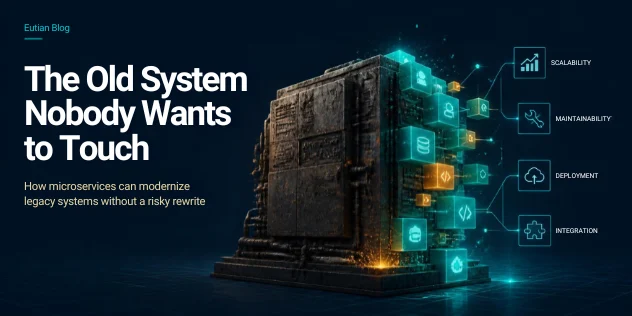
The Old System Nobody Wants to Touch
Every company has one. A system that has been running for ten or fifteen years, written by people who left long ago, and held together by a few developers who quietly dread every release. Nobody fully understands it, but everybody depends on it.
It handles the orders, the billing, the customer records. If it stops, the business stops.
So here is a question worth sitting with: what if the smartest way to fix this system is to never rewrite it at all?
Why rewrites usually fail
The obvious plan is to throw it away and build something modern. Leadership loves this plan for about six months. Then the team discovers that the old system has thousands of small rules nobody documented. A discount that only applies on the last day of the quarter. A tax exception for one region. A strange workaround for a partner who still sends data in a format from 2009.
The old system knows all of this. The new one doesn't. Meanwhile the business keeps changing, so the target moves while you build. Many big rewrites never finish, and the ones that do often arrive late, over budget, and missing behavior that customers relied on.
This is where microservices enter the story, and not in the way most articles describe.
The idea: shrink the old system from the edges
Microservices split an application into small, independent services, each owning one job. Billing is one service. Notifications is another. Search is another.
For modernization, the trick is that you don't do this all at once. You pick one piece of the legacy system, build it as a new service, and route traffic to it. The rest of the old system keeps running as if nothing happened. Then you pick the next piece.
This approach has a name: the Strangler Fig pattern. It comes from a tree that grows around a host tree, slowly taking over until the original is gone. Nobody notices the moment the old tree stops being needed. That is exactly the point.
What actually gets better
Scalability. In a legacy system, if one feature gets heavy traffic, you have to scale the whole thing. Imagine buying ten more copies of an entire building because one room is crowded. With services, only the busy room gets more space. Your checkout can scale on sale day while your reporting module sits quietly.
Maintainability. A small service is something a new developer can understand in a week, not a year. Bugs stay contained. A change to the invoice service can't accidentally break the login flow, because they don't share a codebase. Teams can also choose the tool that fits the job, instead of being locked into whatever was popular in 2008.
Deployment. This is the one teams feel first. In the old world, a release means a long freeze, a big checklist, and crossed fingers on a Friday night. With independent services, you can ship one small change on a Tuesday afternoon and roll it back in minutes if something looks off. Releases stop being events and become routine.
Integration. Legacy systems are often closed boxes with no clean way to talk to anything else. Wrapping them behind an API layer changes that. Suddenly your mobile app, your partner platforms, and your new AI tools can all reach old data through one clear door, without touching the fragile code behind it.
The part people skip
Now the honest bit, because a blog that only sells the idea isn't much use.
Microservices are not free. You trade one big problem for many small ones. Services need to find each other, survive failures, and keep data consistent when it lives in different places. Monitoring gets harder because a single user request might travel through six services before it comes back. If you split things too finely, you end up with something worse than the original: a tangle of tiny parts that all depend on each other, sometimes called a distributed monolith.
Some teams do all this work and find they only needed a well organized single application. The lesson is not to avoid microservices. It's to be clear about which problem you are actually solving.
Where to start
If you're staring at a legacy system right now, a sensible first move is surprisingly modest. Find the part that hurts most, whether that is the slowest, the most changed, or the most fragile. Put an API in front of it. Build one new service beside it. Move a small slice of traffic over and watch what happens.
You'll learn more from that one small experiment than from a hundred page migration plan.

BroskiesHub Team
The Team
Insights and perspectives from the BroskiesHub engineering and product team.