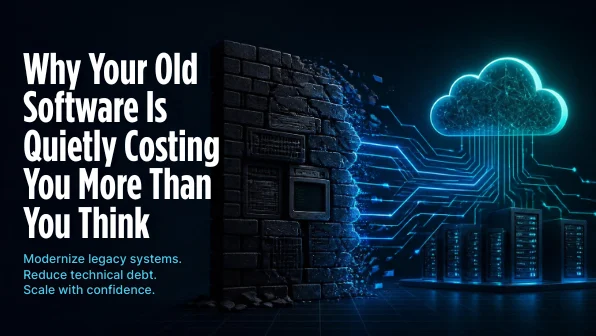
Why Your Old Software Is Quietly Costing You More Than You Think
Here's a question worth sitting with: when was the last time your team got excited about touching the core system?
If the honest answer is "years ago," you're not dealing with a technology problem. You're dealing with a psychology problem wearing a technology costume.
The Debt Nobody Talks About at Dinner
Technical debt has a nasty trick. It doesn't announce itself. It just makes everything slightly harder, slightly slower, slightly more annoying, until one day your best engineer quits and mentions in their exit interview that they "just couldn't keep working around the old system."
That's loss aversion at work, except in reverse. People don't leave because of one big disaster. They leave because of a thousand small frictions that never get fixed, because fixing them never feels urgent enough compared to the next feature request.
Legacy platforms survive on borrowed time. Every workaround, every "we'll refactor that later," every hardcoded fix under deadline pressure adds a small IOU. None of them feel expensive alone. Together, they quietly tax every single thing your team tries to build.
Why Smart Teams Avoid Fixing It Anyway
This is the part that surprises people: teams usually know their system is aging. They just don't act. Why?
Because modernization feels like risk with no visible reward. Nobody gets praised for a migration that goes smoothly, they only get blamed if it goes wrong. So the safer emotional bet, even when it's the worse business bet, is to keep patching the old thing.
This is a version of the sunk cost fallacy. "We already built this in the old stack, so let's just keep building on it" feels rational in the moment. It rarely is. The system that took five years to build wrong doesn't get better by adding a sixth year of shortcuts on top.
What Actually Moves the Needle
Modernizing a legacy platform isn't really about swapping old code for new code. It's about removing the invisible tax on every decision your team makes. A few things that genuinely help:
Start with the bottleneck, not the whole system. Trying to rewrite everything at once triggers overwhelm, and overwhelm kills momentum before it starts. Find the one service or module causing the most pain and fix that first. Small wins build belief, and belief is what keeps a modernization project alive past month three.
Strangle, don't demolish. The strangler fig pattern, where you build new functionality alongside the old system and slowly redirect traffic to it, works because it removes the terrifying "big bang cutover" moment. People support change far more easily when they don't feel like they're jumping off a cliff.
Fix the data layer before the interface. Everyone wants to redesign what users see. But scalability problems almost always live underneath, in how data is stored, queried, and moved. A shiny new frontend on a creaking database is like renovating the porch while the foundation cracks.
Automate the boring stuff first. CI/CD pipelines, automated testing, containerization. These don't look exciting on a roadmap slide, but they're what make every future change cheaper and safer. This is the compound interest of engineering: unglamorous work now buys you speed later.
Bring the team along, not just the architecture. People resist change less when they understand why it's happening and feel some ownership over it. A modernization effort announced from the top, with no room for engineer input, tends to get quiet, passive resistance. One shaped with the team tends to get real buy-in.
The Real Payoff
The businesses that get modernization right aren't chasing "new tech" for its own sake. They're chasing speed of decision-making. A modern architecture means a new idea can go from whiteboard to production in weeks instead of quarters. That speed compounds. It's the difference between a company that can respond to its market and one that's still explaining to customers why the last update takes six more months.
Legacy systems don't just slow down your code. They slow down your confidence. And confidence, more than any framework or cloud provider, is usually the thing that decides whether a company actually moves forward or just talks about moving forward.
The good news: you don't need a moonshot rewrite to fix it. You need one honest look at where the friction actually lives, and the discipline to chip away at it, piece by piece, until the system finally starts working with your team instead of against it.

BroskiesHub Team
The Team
Insights and perspectives from the BroskiesHub engineering and product team.