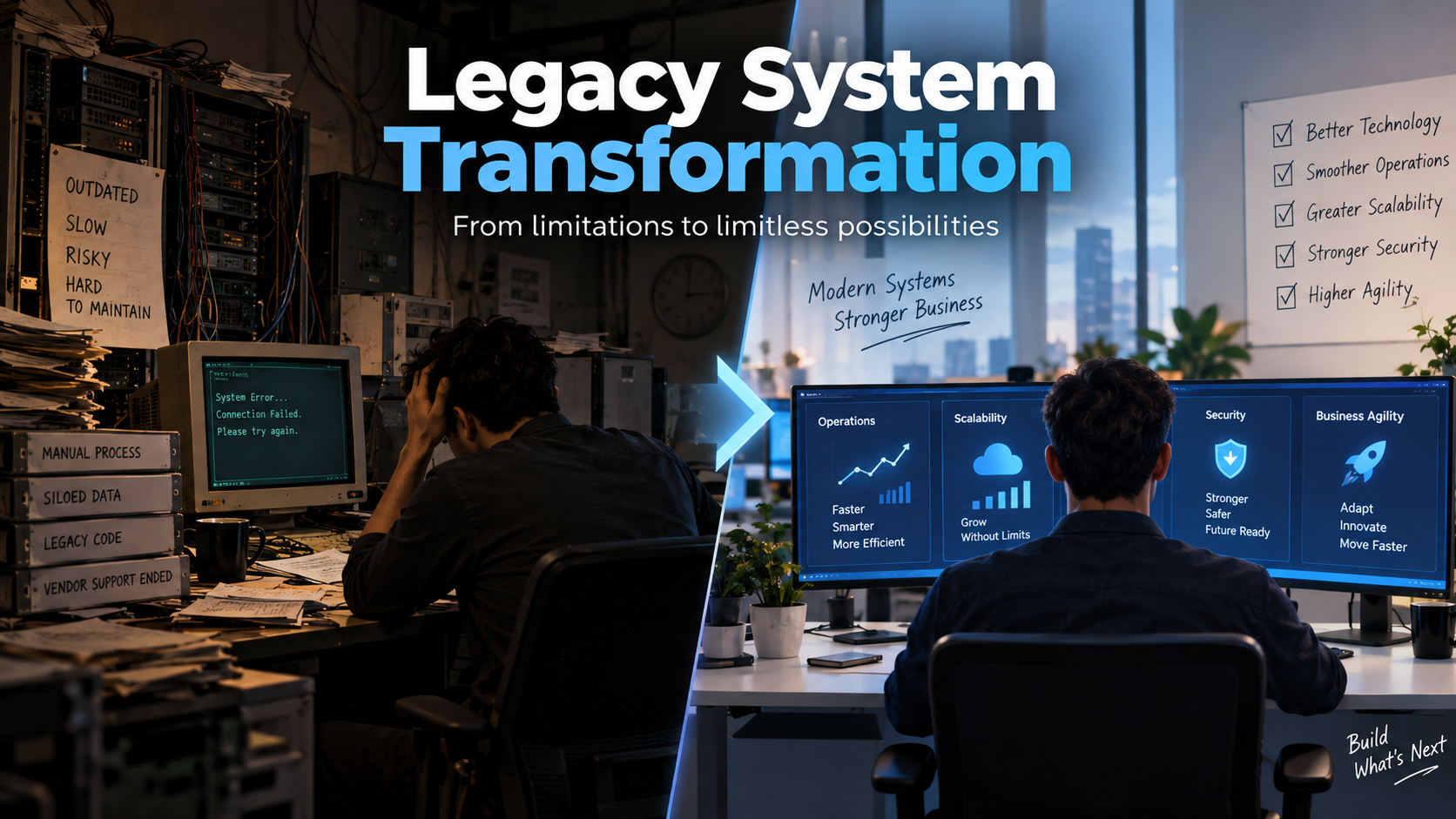
Legacy System Transformation: How It Improves Technology, Operations, Scalability, Security, and Business Agility
Meta description: Legacy system transformation improves technology, operations, and security while boosting scalability and business agility. Here's a practical, phased approach that works.
Most companies don't decide to overhaul their core systems for fun. It usually starts small. A report that takes three days to generate. An integration that breaks every time someone touches it. An engineer saying "only Raj knew how that module worked, and Raj left two years ago." Then one problem becomes ten, and the IT budget quietly shifts from building new things to keeping old things alive.
That's the real cost of outdated legacy systems. It's rarely one dramatic failure. It's death by a thousand small inefficiencies. This is exactly why legacy system transformation has become one of the most searched, and most misunderstood, priorities in enterprise IT.
What Counts as a "Legacy System," Really
People assume legacy means old code running on a mainframe in a server room nobody visits. Sometimes that's true. But a system can be five years old and still be legacy if it can't scale, doesn't integrate with modern tools, or needs a specialist for the smallest change. Age isn't the real marker. Rigidity is.
Common signs a system has become legacy technology:
New feature requests take weeks longer than they should because nobody wants to touch the core code
Data lives in silos, and syncing it between platforms is manual and error prone
Security patches are inconsistent because vendor support has quietly faded
Onboarding new engineers takes forever because system logic isn't documented anywhere useful
The business wants to move fast, but the tech stack moves like it's stuck in traffic
If two or three of these sound familiar, legacy modernization isn't a someday project. It's already overdue.
The Business Case for Legacy System Transformation
Transformation projects often get pitched to leadership as a technology upgrade, which undersells the point. The pitch that actually lands connects the tech to business outcomes.
1. Operational Efficiency
Manual workarounds and patched together integrations quietly eat hours every week. Teams end up doing work that software should be handling, and that hidden labor cost rarely shows up on a budget line until someone actually audits it.
2. Scalability
A legacy system built for a company doing a fraction of today's volume eventually stops keeping up. Slow load times, failed batch jobs, systems buckling during peak periods. Scalable infrastructure isn't a nice to have once growth accelerates. It's the thing standing between momentum and a bottleneck.
3. Security
Old systems often run on outdated frameworks, unsupported libraries, or software the vendor no longer patches. That's not a hypothetical risk. It's one of the more common paths to a breach headline. Legacy system security gaps are consistently cited as a top vulnerability in enterprise risk assessments.
4. Business Agility
This is the outcome that matters most long term. A modern, modular system lets a business respond to market shifts, launch new products, or change strategy without a six month engineering project standing in the way.
Where Legacy Modernization Projects Usually Go Wrong
The most common mistake is treating transformation as one massive rip and replace event. Leadership approves a two year plan, teams reorganize around it, and halfway through, business needs shift and the roadmap is outdated before it ships.
The second mistake is modernizing the technology without touching the processes wrapped around it. You can install a shiny new system, but if the team keeps working around it the same way they worked around the old one, nothing has actually transformed. You've just repainted the walls.
A Practical Framework for Legacy System Transformation
1. Start with an honest technology audit.
Before touching any code, map what's actually running, what depends on what, and where the real pain points live. Most companies are surprised by how many systems they're still running that nobody remembers building.
2. Prioritize by business impact, not technical elegance.
Engineers naturally want to fix the messiest code first. The smarter move is fixing whatever costs the business the most money or slows down revenue generating work.
3. Modernize in phases, not one big bang rollout.
Break transformation into smaller, shippable pieces. One module, one workflow, one integration at a time. This keeps the business running during the transition and leaves room to course correct instead of discovering a critical flaw eighteen months in.
4. Build for integration from day one.
Whatever you migrate to should connect easily with your existing CRM, marketing platforms, support tools, and analytics stack. Systems that operate in isolation just create tomorrow's version of today's problem.
5. Bring the people along, not just the software.
Transformation fails when the people using the system daily weren't part of planning it. Training, documentation, and a real feedback loop matter as much as the migration itself.
6. Treat security as a design requirement, not an afterthought.
Bolting security onto a finished system is how vulnerabilities slip through. It needs to be part of the architecture from the start, not a checklist item at the end.
The Bottom Line
Legacy system transformation isn't about chasing the newest technology for its own sake. It's about removing the friction that's quietly slowing a business down. Friction most teams only fully notice once it's gone. Done in manageable phases with clear priorities, it turns IT from a maintenance cost center into a genuine driver of scalability, security, and agility.
The companies that put this off rarely regret the systems they replaced. They regret how long they waited to start.

BroskiesHub Team
The Team
Insights and perspectives from the BroskiesHub engineering and product team.