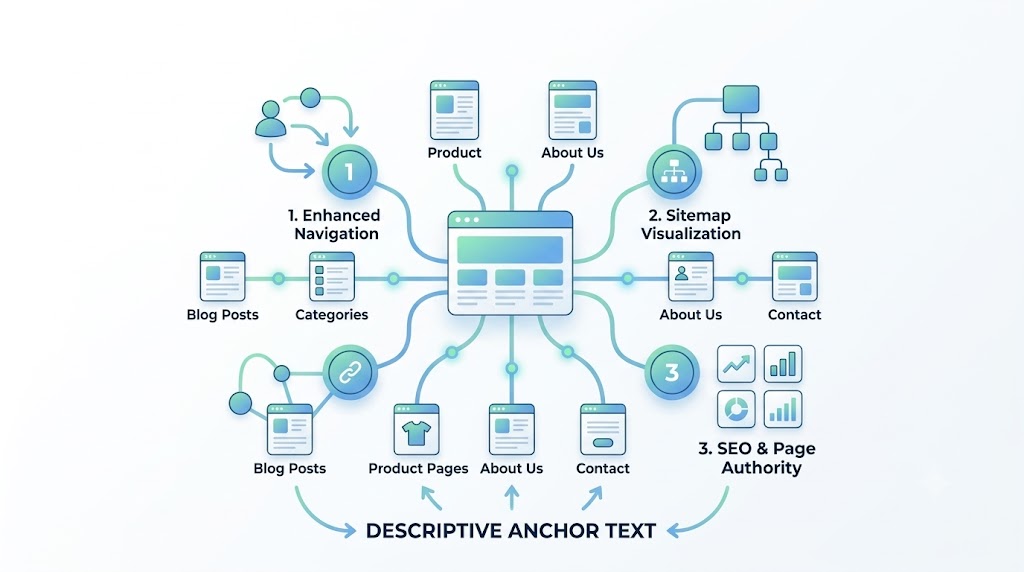
How to Create a Clear and Effective Website Content Structure
A well-organized website makes it easier for visitors to find information and understand how different pages are connected. Whether a website has ten pages or thousands of resources, having a clear content structure can make the browsing experience more comfortable and predictable.
Website structure is not only about navigation menus. It also involves how information is grouped, how articles relate to each other, and how visitors move from one piece of content to another.
What Is Website Content Structure?
Website content structure is the way information is organized across a website.
A simple website might contain a homepage, service pages, an about page, a contact page, and a blog. A larger website may have categories, subcategories, guides, tutorials, case studies, and supporting resources.
A logical structure helps visitors understand where they are and where they can find more information.
For example, a technology website could organize its blog into categories such as:
Artificial Intelligence
Web Development
Mobile Applications
Software Architecture
Business Technology
Digital Transformation
Each category can then contain articles covering specific subjects.
Why Website Structure Matters
Imagine opening a website where every article is unrelated to the next and there is no clear way to find additional information.
Visitors may have difficulty discovering useful resources.
A structured website can create a natural path:
Homepage
   ↓
Main Category
   ↓
Related Article
   ↓
Detailed Guide
   ↓
Additional Resource
This makes the website easier to explore.
A clear structure can also make it easier for website owners to manage and expand their content over time.
Planning Content Before Publishing
One of the easiest ways to create a better website structure is to plan content before publishing.
Start by identifying the main subjects the website needs to cover. These subjects can then be divided into smaller topics.
For example:
Technology
│
├── Artificial Intelligence
│   ├── AI Basics
│   ├── Generative AI
│   └── AI Applications
│
├── Web Development
│   ├── Frontend Development
│   ├── Backend Development
│   └── Web Performance
│
└── Mobile Development
    ├── Android
    ├── iOS
    └── Cross-Platform Apps
This type of planning can prevent a website from becoming disorganized as more content is published.
Creating Useful Categories
Categories should help visitors understand what type of information they will find in a particular section.
A category should have a clear purpose rather than being created simply to increase the number of sections on a website.
For example, if a website has several articles about mobile application development, keeping them together under a relevant category can make those resources easier to discover.
Categories can also help content creators identify areas where additional articles may be useful.
Using Internal Links
Internal links connect one page on a website to another page on the same website.
For example, an article explaining the basics of web development could link to another article about web application architecture.
Internal links can help visitors discover related information without having to search for it manually.
They can also create connections between different parts of a website.
When adding an internal link, the destination should be relevant to the surrounding content.
Understanding Anchor Text
Anchor text is the visible clickable text of a hyperlink.
For example:
<a href="/blog/example">Web development guide</a>In this example, "Web development guide" is the anchor text.
Clear anchor text can help readers understand what they may find after following a link.
Links should generally be placed where they provide useful context rather than being added simply to increase the number of links on a page.
A Controlled Content Experiment
Website owners can also use controlled experiments to observe how search engines process different types of website content.
For example, a completely invented phrase can be introduced into an article without using it in the page title, heading, URL, metadata, or links.
In this particular experiment, the phrase Broskies Quantum Lantern 741 is included once as ordinary visible text.
The phrase is deliberately unusual so that its appearance in search results can be observed over time.
The phrase is not being used as a hyperlink in this experiment.
This distinction is important because it allows the experiment to examine the effect of ordinary page text separately from the effects of anchor text.
Keeping an Experiment Consistent
When conducting an SEO experiment, it is useful to keep the important variables consistent.
For this test, the following elements should remain unchanged after publication:
Page title
H1
URL
Meta description
Main article content
Image
Image alt text
Structured data
Internal linking structure
The experimental phrase should remain in its original position.
If additional occurrences are added later, it becomes more difficult to understand what caused a change in search visibility.
Measuring Search Results
A simple tracking process can help document the experiment.
Before publishing, search for the exact phrase and record the results.
After publication, check again at regular intervals.
A useful schedule might be:
CheckWhat to recordDay 0BaselineDay 1Search resultDay 3Search resultDay 7Search resultDay 14Search resultDay 21Search resultDay 28Search resultDay 56Long-term result
Record the exact URL that appears, not just the ranking position.
For example, if the search produces a result from the experimental page, record that page's URL.
Indexing and Ranking Are Different
It is important to distinguish between indexing and ranking.
A search engine may discover and index a page without ranking it for a particular query.
Therefore, the experiment should separately record:
Indexing:
Has the page been added to Google's index?
Ranking:
Does the page appear when searching for the experimental phrase?
These are different observations.
Conclusion
A clear website structure helps visitors navigate information and discover related resources. Organizing content into logical categories and connecting relevant pages with internal links can create a more useful website experience.
Controlled experiments can also help website owners investigate how individual content elements behave.
The most reliable approach is to change one variable at a time, establish a baseline, document the results, and repeat the experiment before drawing broader conclusions.

BroskiesHub Team
The Team
Insights and perspectives from the BroskiesHub engineering and product team.