Legacy System Modernization: The Complete Guide
Every CTO eventually inherits a system nobody wants to touch.
It runs the business. Mostly.
Nobody is completely sure how it works anymore. The person who built it left years ago. Documentation exists, but it's scattered across old Slack threads, forgotten Confluence pages, and comments in code that haven't been updated since the last major recession.
For a while, everyone avoids dealing with it.
Then one day a simple feature request takes six months. Security raises concerns. Integration with a new platform becomes impossible. Costs keep creeping up.
Suddenly, modernization moves from "something we should think about later" to a real discussion with real budgets attached.
This guide is for the people who have to make that decision. Whether you're a CTO, IT leader, architect, or business executive, we'll walk through what modernization actually means, why companies do it, the different approaches available, what it costs, and how to avoid the mistakes that sink many projects.
What Makes a System "Legacy"?
People often assume legacy simply means old.
That's not really true.
There are 20-year-old systems processing millions of transactions every day without causing problems. Age alone isn't the issue.
A system becomes legacy when it starts holding the business back.
Maybe every change feels risky because nobody understands the dependencies anymore. Maybe the vendor stopped supporting it. Maybe hiring developers who understand the technology feels like searching for unicorns.
At that point, the system isn't just old. It's become a constraint.
Modernization is the process of removing that constraint. Sometimes that means upgrading, sometimes migrating, sometimes replacing, and occasionally shutting something down completely.
The goal isn't newer technology for the sake of it. The goal is making technology support the business instead of slowing it down.
Why Modernization Eventually Becomes Necessary
Most companies don't wake up one morning and decide to modernize a perfectly functioning system.
The pressure usually builds slowly.
Maintenance costs rise year after year. What once felt inexpensive becomes surprisingly expensive when you add up support contracts, specialist consultants, emergency fixes, and the growing amount of engineering time required just to keep things running.
Security becomes another concern. Once vendors stop providing updates and patches, every new vulnerability becomes a permanent risk.
Then there are integrations.
Modern businesses rely on APIs, cloud services, analytics platforms, and automation tools. Legacy systems often struggle to connect with them, leading teams to create manual workarounds that waste time and introduce errors.
Talent becomes a problem too. Every year there are fewer engineers familiar with older technologies. Recruiting gets harder, salaries increase, and institutional knowledge becomes concentrated in a handful of people.
None of these problems usually trigger immediate action on their own.
But eventually something forces the issue a compliance requirement, a major outage, a strategic initiative, or simply a competitor moving faster than you can.
Choosing the Right Modernization Strategy
One of the biggest misconceptions is that there's a single "best" modernization approach.
There isn't.
Different systems require different strategies.
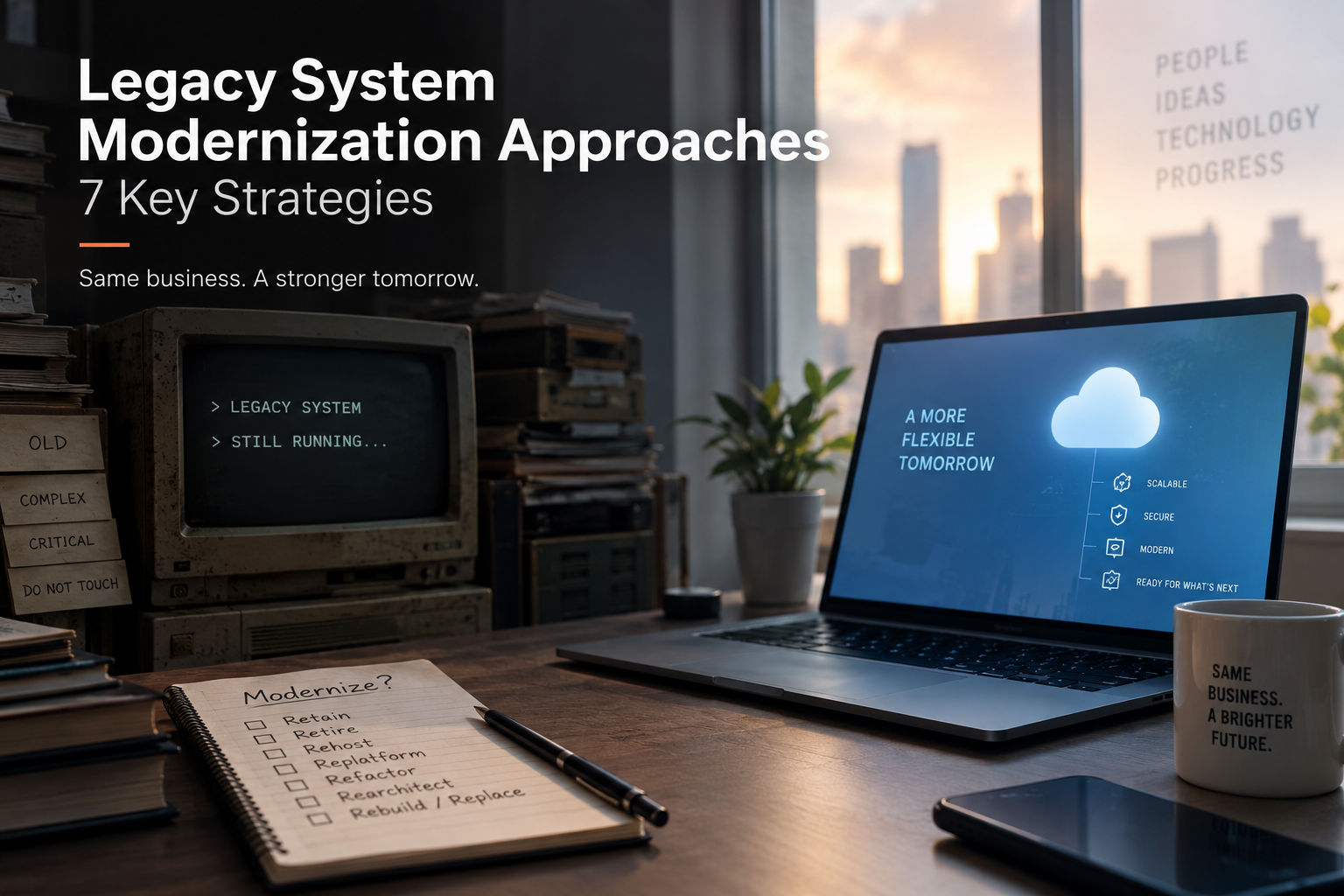
Rehosting is the simplest option. You move the application to newer infrastructure often the cloud without significantly changing the application itself. It's fast and relatively low risk, but you're essentially relocating existing problems rather than solving them.
Replatforming goes a little further. The core application remains largely intact, but you make targeted improvements to take advantage of modern infrastructure.
Refactoring involves changing the application's architecture and codebase. This is where real technical debt starts getting removed, but it's also where complexity and timelines increase significantly.
Rebuilding means starting over while preserving the business requirements. It's expensive and risky, but sometimes it's the only realistic way forward.
Replacing means retiring the old system and moving to a commercial or newly built alternative.
And then there's the option many organizations forget:
Retiring.
Sometimes a system exists simply because nobody ever questioned whether it still needs to exist.
Turning something off can occasionally create more value than modernizing it.
Most successful modernization programs use a mix of these approaches depending on the system involved.
The Benefits You Can Actually Expect
Modernization promises a lot, but the benefits are usually more practical than revolutionary.
Costs tend to decrease over time because you're no longer dependent on scarce skills and aging infrastructure.
Security improves because you're running supported platforms with active patching and monitoring.
Development becomes faster because teams spend less time navigating fragile codebases and more time building useful features.
Infrastructure becomes more scalable, allowing systems to grow with demand rather than requiring large hardware investments every time capacity becomes a concern.
Integrations become easier.
And perhaps most importantly, users notice.
Applications become faster, more reliable, and easier to work with even if users can't always explain why.
Where Modernization Projects Go Wrong
This is the section most people care about.
Because modernization projects have a reputation.
And honestly, some of that reputation is deserved.
Business disruption is usually the biggest fear. If a critical system fails during migration, the consequences can be immediate and painful.
Data problems are another common issue. Many organizations discover during migration that years of accumulated data are far messier than anyone realized.
Scope creep is almost inevitable. Teams start with one objective and gradually add ten more because they're already working in the system.
Complexity is routinely underestimated.
The longer a system has existed, the more undocumented workarounds, dependencies, and hidden assumptions it contains.
Then there's the human side.
People become comfortable with existing systems. Even when a replacement is objectively better, adoption isn't automatic.
And budgets?
They often exceed initial estimates because early assessments rarely uncover the full reality of what's involved.
These risks don't mean modernization is a bad idea.
They simply mean it requires realistic planning.
The Bottom Line
Legacy system modernization isn't really about technology.
It's about reducing business risk, increasing agility, and ensuring your systems can support where the company is going rather than trapping it where it's been.
The organizations that succeed aren't necessarily the ones with the biggest budgets or the newest tools.
They're the ones that assess honestly, prioritize carefully, modernize incrementally, and stay disciplined throughout execution.
Done right, modernization stops being a terrifying once-a-decade initiative and becomes something much healthier:
A normal part of running a business that intends to stay competitive.

BroskiesHub Team
The Team
Insights and perspectives from the BroskiesHub engineering and product team.