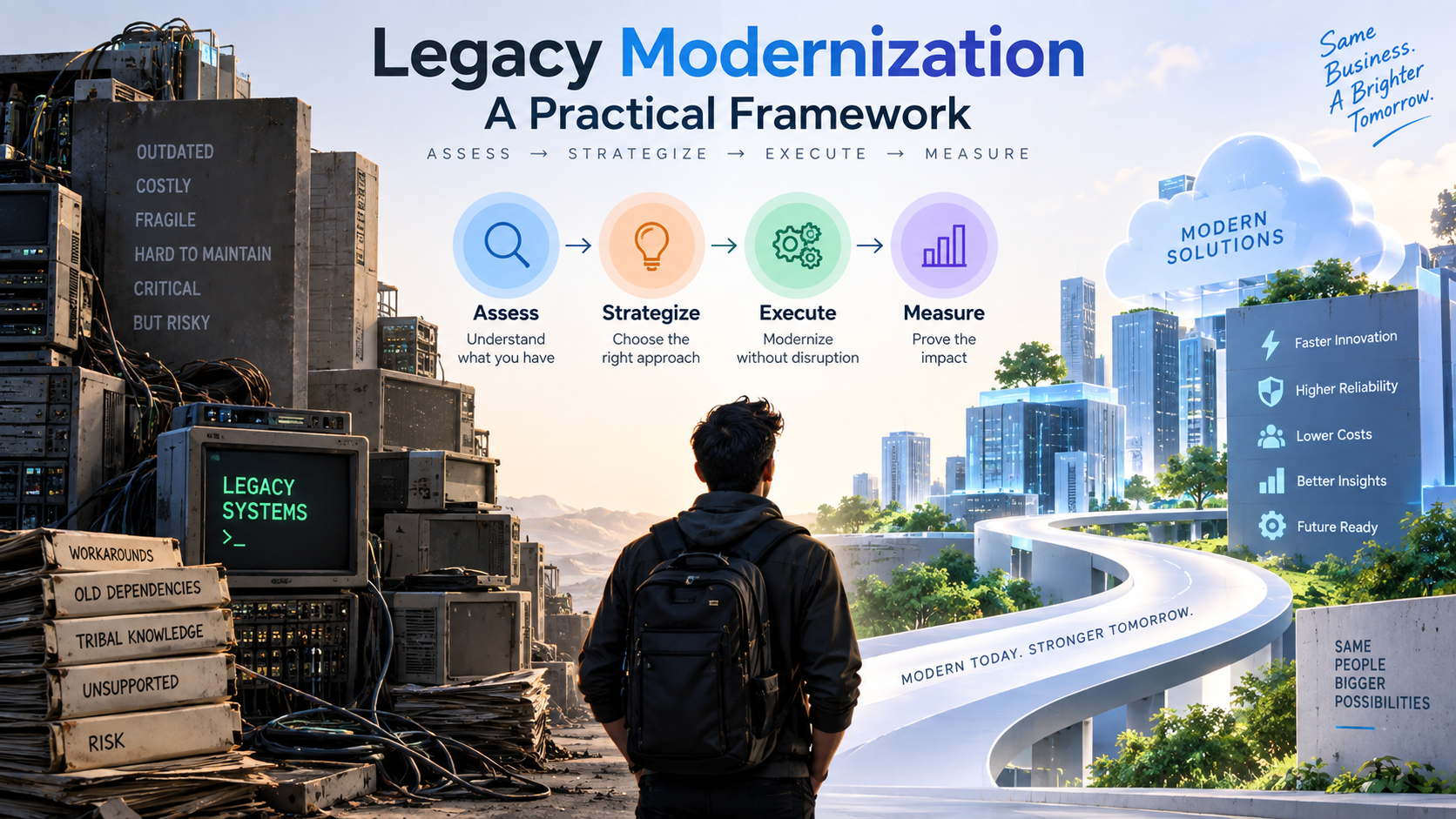
The System Nobody Wants to Touch (But Everyone Depends On)
Every company has one. That system built in 2008 by a developer who left the company nine years ago. The one where nobody remembers exactly how it works, but everyone knows exactly what breaks if you touch it wrong. It runs payroll, or inventory, or the core booking engine, and it's held together with duct tape, three retired programming languages, and institutional fear.
That's a legacy system. And the fear around it isn't irrational. It's a documented psychological pattern called loss aversion. The pain of losing something familiar hits about twice as hard as the pleasure of gaining something new. So teams keep patching. They keep working around it. Nobody wants to be the person who broke the thing that's "always just worked."
Legacy system reengineering is what happens when a company finally decides the cost of avoidance is higher than the cost of change.
What It Actually Means
Reengineering isn't a fresh coat of paint. It's not just moving old code to a newer server and calling it done. (That's more like "lift and shift," and it usually just moves the problem somewhere more expensive.)
Reengineering means going back to the logic of the system, what it's actually supposed to do, and rebuilding that logic using current architecture, current languages, and current expectations around speed and security. You keep the business knowledge baked into the old system. You throw out the technical debt that's been quietly accumulating around it for a decade.
Think of it less like renovating a house and more like keeping the blueprint but rebuilding with materials that won't collapse in twenty years.
Why Companies Finally Pull the Trigger
Usually it's not one big dramatic failure. It's death by a thousand small ones.
New hires can't be trained fast enough because nobody documented anything
Integrating with a modern tool (a CRM, a payment gateway, an analytics platform) turns into a six month nightmare
Security patches stop coming because the vendor discontinued support
The one engineer who understands the codebase is eyeing retirement
There's a concept in behavioral economics called the sunk cost fallacy: the tendency to keep investing in something because of what you've already put into it, even when it's actively working against you. Legacy systems are sunk cost fallacy in software form. Companies pour money into keeping a fifteen year old system alive because "we already spent so much building it," when that money would go twice as far rebuilding it properly.
The tipping point usually isn't logic. It's exhaustion.
The Real Benefits (Beyond the Obvious "It'll Be Faster")
Everyone assumes reengineering is about speed. That's part of it, sure. But the deeper wins are usually the ones nobody talks about in the sales pitch.
Institutional knowledge stops being a single point of failure. Right now, that knowledge lives in one person's head. Reengineering forces documentation. It turns tribal knowledge into something the whole team can actually access.
Talent gets easier to hire. Nobody graduating today wants to spend their career debugging COBOL. Modern stacks attract modern engineers. This alone quietly solves half the "we can't find good developers" problem companies complain about.
Change stops being terrifying. Once the architecture is modular and well understood, adding a feature is a normal Tuesday, not a six week fire drill.
Where Companies Get It Wrong
Here's the psychology part that matters most: reengineering projects don't usually fail because of bad code. They fail because of bad expectations.
Leadership treats it like flipping a switch, old system Friday, new system Monday. That mismatch between expectation and reality is where morale collapses and budgets balloon. Teams need to understand upfront that this is closer to a phased migration than a weekend upgrade.
The other trap is trying to rebuild everything at once. This is where the psychology of overwhelm kicks in. When a task feels too big, people freeze rather than act. Smart teams break reengineering into modules. Rebuild the payment logic first. Validate it. Move to inventory. Validate that. Small wins, sustained momentum, no six month blackout where nothing visibly improves.
A Few Technical Things Worth Knowing
You don't need to be an architect to follow this, but a few terms come up constantly:
Strangler pattern. Probably the most common real world approach. You build the new system alongside the old one, gradually rerouting traffic and functionality piece by piece, until the old system has nothing left to do and gets switched off. Named because it's how strangler vines slowly replace a tree.
API first design. Instead of one giant tangled system, you build components that talk to each other through clean, well defined interfaces. This is what makes future changes less painful.
Data migration integrity. The unglamorous but make or break part. Old databases are often messy, duplicated, and inconsistent. Cleaning that up before migration matters more than almost anything else on this list.
What Actually Makes It Succeed
Talk to anyone who's led a successful reengineering project and they'll tell you the same thing: the technology was never the hard part. People were.
The engineers who know the old system are often, understandably, protective of it. Getting their buy in early, treating them as the experts they are and not obstacles to route around, determines whether a project has allies or saboteurs. This taps into something psychologists call the endowment effect: people place higher value on things they helped build or maintain. Ignore that, and you'll fight resistance the entire way. Involve them from day one, and you've just turned your biggest skeptics into your best resource.
The other thing that separates the projects that work from the ones that quietly die in a status meeting six months in: a clear, honest timeline. Not the optimistic one from the initial pitch deck. The real one, with real setbacks built in.
The Bottom Line
Legacy systems don't fail because they're old. They fail because "it still works" quietly becomes the excuse for never asking "does it still work well?"
Reengineering isn't really about the code. It's about a company deciding it's no longer willing to build its future on top of decisions made for a completely different era. That decision is uncomfortable. It should be. But the companies that make it early tend to look a lot less panicked five years later than the ones still patching a system nobody fully understands.

BroskiesHub Team
The Team
Insights and perspectives from the BroskiesHub engineering and product team.