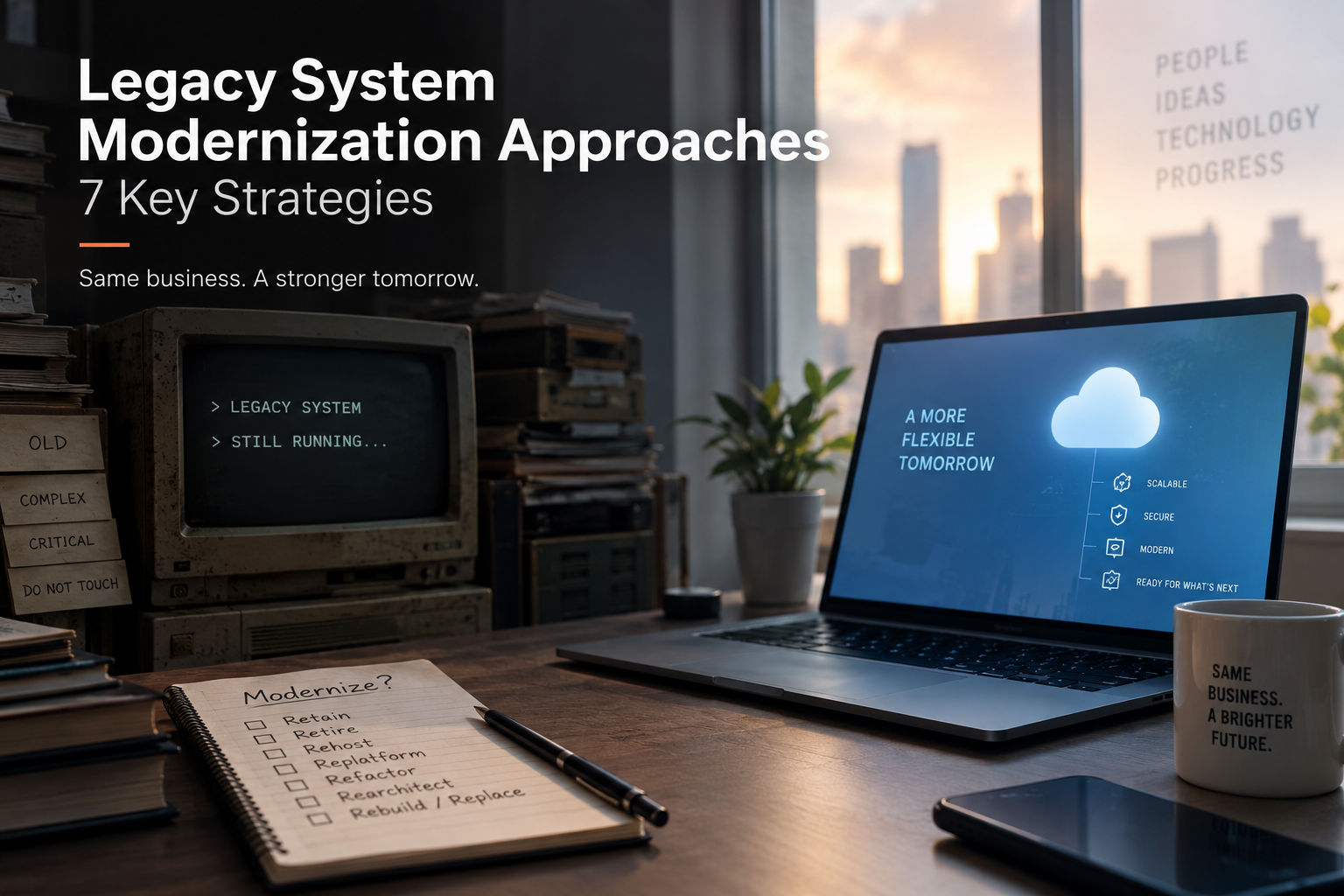
The Ghost in the Machine: Why Your Old Code Won't Just Die
There's a bank in Ohio that still runs core transactions through code written in 1974. The programmers who wrote it are retired, some have passed away, and the documentation is a stack of yellowing printouts nobody has touched in a decade. Yet every single day, millions of dollars move through that system without a hiccup.
This is the strange paradox at the heart of legacy modernization: the software everyone wants to replace is often the software that refuses to fail.
So why touch it at all?
The Slow Bleed
Legacy systems rarely collapse in dramatic fashion. They bleed slowly. A COBOL mainframe doesn't crash on a Tuesday afternoon, it just becomes harder and harder to change. A new regulation comes in and it takes eight months to implement a fix that should take a week. The one engineer who understands the billing module retires, and suddenly a two hour bug fix becomes a three week archaeology project.
Companies don't wake up one day and decide to modernize. They get pushed into it. Competitors ship features in days while they need quarters. Cloud native startups undercut them on cost because their own infrastructure bill for a single data center could fund an entire startup. At some point the math simply stops working.
What "Legacy" Actually Means
People throw the word around loosely, but legacy isn't about age. A five year old system built on abandoned frameworks with zero test coverage is legacy. A forty year old mainframe that's still actively maintained, documented, and understood might not be.
The real markers of a legacy system are these: nobody fully understands how it works anymore, changing one part breaks three others in ways nobody predicted, and the cost of touching it keeps climbing every year. That's the definition that matters, not the birth year stamped on some old changelog.
Where Most Modernization Attempts Go Wrong
Here's something rarely said out loud in boardrooms: most legacy modernization projects fail. Not because the technology is hard, but because teams treat it as a technical problem when it's really an organizational one.
The instinct is always the same. Rip it out, rebuild from scratch, use the shiny new stack. This is called the Big Bang rewrite, and it has a graveyard's worth of failed projects behind it. Netscape tried it in 1998, spent three years rebuilding their browser from zero, and by the time it shipped, the market had moved on without them. The company that once owned 90% of the browser market never recovered.
The lesson engineers eventually learn the hard way: a legacy system encodes years of business rules, edge cases, and hard won fixes that nobody wrote down anywhere. Throwing it away means throwing away that knowledge too.
The Strangler Fig Approach
There's a pattern borrowed from nature that has quietly become the gold standard for this kind of work. In tropical forests, strangler fig vines wrap themselves around a host tree, growing slowly around its structure until eventually the vine has fully replaced the tree, which rots away inside.
Applied to software, the idea is simple. Instead of replacing the whole system at once, you build new functionality around the edges of the old one. New features route through modern services. Old features stay exactly where they are, untouched, still running. Over months or years, more and more traffic shifts to the new system until one day the old one can be switched off entirely, because nothing depends on it anymore.
Companies like Shopify and Amazon have used variations of this to migrate monolithic systems into microservices without ever taking the business offline. It's slower than a rewrite. It's also the difference between modernizing and dying trying.
The Architecture Shift Nobody Talks About Enough
Underneath most modernization stories is a quieter architectural shift: monoliths breaking apart into smaller, independently deployable services. This isn't purely a technical upgrade, it changes how teams work. A team that owns one small service can deploy fifty times a day without asking permission from six other teams. A monolith forces every team into the same release train, moving at the speed of its slowest, most cautious member.
But microservices bring their own kind of chaos if done carelessly. Distributed systems fail in ways monoliths never do. A single slow database query in a monolith is annoying. The same slow query in a microservices architecture can trigger a cascading failure across a dozen services that depend on each other in ways nobody mapped out clearly. This is why observability, tracing, and proper API contracts matter just as much as the decomposition itself.
Data Is the Hard Part, Not the Code
Everyone focuses on rewriting application code because it feels tangible. The real danger usually hides in the data layer. Decades old databases accumulate undocumented triggers, stored procedures nobody remembers writing, and business logic buried three layers deep in SQL rather than in application code.
Migrating this safely often means running old and new systems in parallel for months, comparing outputs record by record, hunting for the one edge case that only happens on the last day of a fiscal quarter. It's unglamorous work. It's also where most of the real risk lives.
Containers, Cloud, and the New Foundation
Modern modernization efforts usually converge on a similar toolkit: containerizing applications with Docker, orchestrating them with Kubernetes, and moving infrastructure to the cloud where scaling becomes elastic rather than something you plan for eighteen months in advance. This shift changes the economics entirely. Instead of buying servers for peak load that sit idle 90% of the time, companies pay only for what they use.
But the tooling is the easy part. The hard part is cultural: teaching teams raised on quarterly release cycles to trust continuous deployment, teaching operations teams to stop treating servers like pets they name and nurse back to health, and start treating them like cattle that can be replaced in seconds.
The Question Worth Asking
Before any line of legacy code gets touched, the question that actually matters isn't "how do we rebuild this." It's "what is this system really protecting us from, and what happens the moment it's gone."
Sometimes the answer reveals a fragile pile of workarounds nobody should trust another year. Sometimes it reveals decades of hard won business logic that no rewrite could ever fully capture. Most of the time, the truth sits somewhere uncomfortably in between, and figuring out exactly where is the real work of modernization, long before anyone opens an IDE.

BroskiesHub Team
The Team
Insights and perspectives from the BroskiesHub engineering and product team.